

Throughout the development of the Sustainable Transportation Strategy, the planning team attended and hosted multiple community events to build awareness about campus transportation and parking challenges. Based on the five key values and four Cs, public engagement took many forms, including a hackathon, a custom board game, workshops and presentations.
Five Key Values
The Sustainable Transportation Strategy is guided by five key OSU values. The following institutional values informed the selection of strategies and policies to reduce drive-alone trips to the Corvallis campus.
Climate Action: Be bold in addressing the climate crisis.
Good Neighborhood Relations: Help to reduce traffic and parking impacts in adjacent neighborhoods.
Equity and Affordability: Ensure affordable access to education and employment for individuals at all income levels.
Land Preservation: Preserve land for education, research and open space.
Financial Stewardship: Use financial resources wisely to maximize return on investment and support our values.
The Four Cs
The Sustainable Transportation Strategy is built on a foundational framework called the Four Cs, which recognizes that individual transportation choices are influenced by these four categories:
Cost: This includes both the total travel costs for different transportation modes as well as how individuals experience those costs.
Culture: How are transportation alternatives supported by OSU's culture, through examples and messages from supervisors, colleagues and peers.
Convenience: The degree to which alternatives to driving are comparably easy and efficient.
Concrete: The built environment that supports mobility options, including everything from on-campus facilities such as bike parking to public amenities such as transit stops.
Stakeholder Engagement
- OSU Leadership steered the plan, providing direction to the project team by establishing guiding values, setting goals and reviewing drafts. This group included the Provost and members of OSU’s senior leadership.
- The OSU Transportation Committee, composed of department and student representatives from across OSU, served as the advisory committee and sounding board for the plan.
- The project team submitted OSU’s TDM planning effort as a community initiative to the Imagine Corvallis Action Network (ICAN) Advisory Board, a city advisory board charged with implementing the Imagine Corvallis 2040 Vision.
- The project team sought input from the Oregon State Environmental Council (a committee of the Associated Students of OSU (ASOSU)) as well as the Transportation Subcommittee of the Faculty Senate Ad Hoc Committee on the Carbon Commitment.
Transportation and Parking Workshop
June 18, 2019
Cascade Hall, OSU
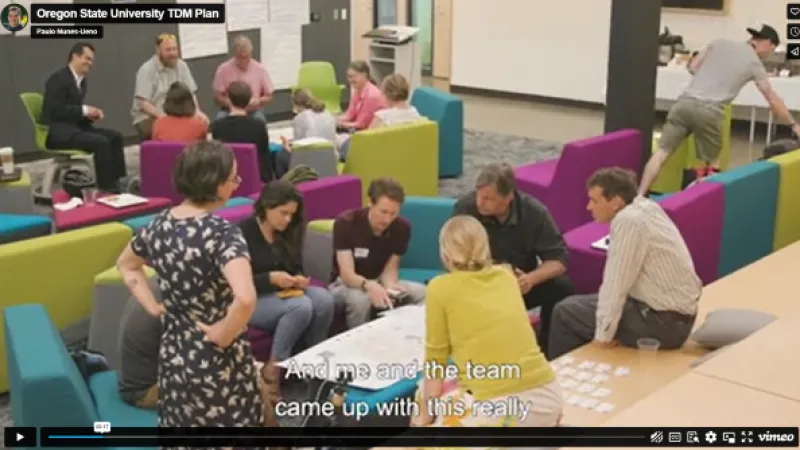
OSU Transportation Services hosted a Transportation and Parking Workshop for on-campus stakeholders to explore the concepts behind the Four Cs (Culture, Cost, Convenience and Concrete) that shape our transportation choices. Through a "Mobility Hackathon," the group brainstormed strategies (or "Mobility Hacks") to get more OSU students and employees to try alternative transportation options. Participants then applied those strategies through a board game. Groups had to build a multimodal transportation system for a fictitious OSU campus in 2030. With a limited budget, limited land available for development, and a suite of "Mobility Hacks" to offset parking demand, groups developed scenarios to accommodate future growth while also reducing greenhouse gas emissions and preserving open space.
Sustainable Transportation Game Night
January 30, 2020
Student Experience Center, OSU
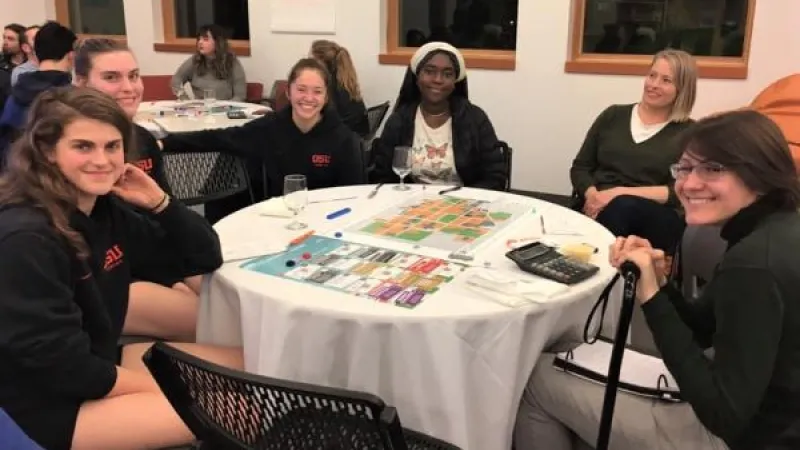
A full house of students attended the Sustainable Transportation Game Night. Attendees played a board game about transportation and parking at OSU, and grappled with the tradeoffs of building parking on campus or paying for alternative transportation programs. Afterward, the group had a lively conversation in which students shared the transportation strategies they hope OSU will implement. Highlights included suggestions for higher transit frequency, more pedestrian-scale street lighting, and improved bike routes to campus. Many voiced the importance of keeping transportation costs low for students with limited financial resources.
This event was co-hosted by OSU Transportation Services and Associated Students of OSU (ASOSU)
SHIFT OSU: A Sustainable Campus Transportation Workshop
Tuesday, February 25, 2020
Corvallis High School Commons
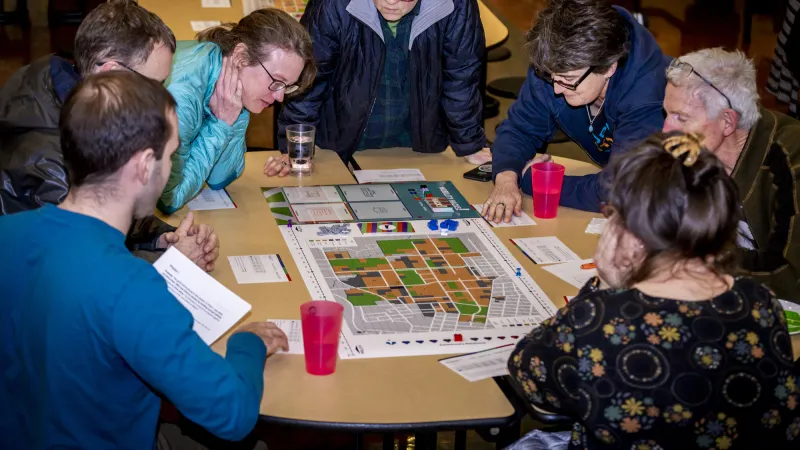
How can OSU’s transportation investments preserve open space, reduce carbon emissions, and support affordability for students and staff? In February of 2020, OSU Transportation Services and the Imagine Corvallis Action Network (ICAN) co-hosted a community workshop to explore these ideas. Attendees included neighborhood residents, elected officials, and transportation activists.
Project Team
Nunes-Ueno Consulting
Paulo Nunes-Ueno, Principal
OSU Transportation Services
Meredith Williams, Director
Sarah Bronstein, Sustainable Transportation Manager
OSU Capital Planning and Development
Bob Richardson, Planning Manager